You are here: New York Home Home

Featured Lots

2655 19th Century Marble Topped Console Table
2649 19th Century Marble Hercules, by Farnaesi
£150,000 chimneypiece leads Jamb sale
Tuesday, 07 February 2012 18:00
06 February 2012
BIDDERS in the room, on the phones and the internet were all in action last week to contest the 475-lot sale of the collection of Will Fisher, founder of London dealers Jamb, at Christie's South Kensington.

The auction on February 2 comprised mixed pieces from Mr Fisher's Camberwell home and stock from his Pimlico Road gallery, from which he is moving to new premises.
The sale had been estimated to fetch £1.4m-2.4m, but with plenty of the pieces that made up the distinctive Jamb look contested well past expectations by multiple bids, the all-day event ended up totalling £3.15m hammer.

Chimmeypieces are a Jamb speciality and the day's top lot was the 7ft 10in (2.4m) wide, mid-18th century example pictured here, in verde antico and statuary marble, made to a Palladian-inspired design by Isaac Ware.

It was possibly carved in the workshop of James Richards and fetched £150,000, plus premium.

By Anne Crane

 
Sotheby’s Post Strong Sales Results
Friday, 03 February 2012 17:49
International
Sotheby’s post strong sales results
30 January 2012
SOTHEBY’S have posted $4.9bn in worldwide sales for 2011, marginally up on 2010.

The United States remains the company's primary market, accounting for just over $1.9bn of sales, with the UK second at $1.5bn. Continental Europe yielded $527m, while Asia – largely Hong Kong-based sales – totalled $959m.

The company's biggest grossing sale of the year was the $315.8m Contemporary art evening sale in New York on November 9, followed by the $199.8m Impressionist and Modern art evening sale that took place, also in New York, a week earlier. Together they account for 10.5% of the entire year's sales total.

Dedicated Contemporary art sales, as a whole, brought in around $860m-870m, while those focusing on Impressionist and Modern art totalled around $1.48bn. Neither of these figures, nor those for other specific disciplines, take into account additional material that may have formed part of mixed sales or single-owner collections.

Of the other leading disciplines, jewellery made around $380m, Old Masters – paintings, prints, drawings and sculpture – around $150m, Asian art around $165m and antiquities close to $50m.

The importance of Chinese paintings and works of art was clearly underlined by a total of more than $650m.

By Ivan Macquisten

 
Art review: 'Leonardo da Vinci: Painter at the Court of Milan'
Friday, 09 December 2011 22:10
In the second room of "Leonardo da Vinci: Painter at the Court of Milan," a moving and unprecedented exhibition at the National Gallery, what some regard as the most beautiful portrait in the long history of European art draws a viewer in close. "Portrait of Cecilia Gallerani (The Lady With an Ermine)" shows the radiantly lovely, 16-year-old mistress of Ludovico Sforza, despotic ruler of Milan and the artist's boss. She stares into an unseen distance while gently stroking the soft neck of an alert, snow-white ermine cradled in her arms.

Her torso twists in three-quarter view turned to her right, while her head is in three-quarter view turned to her left. It's as if the young lady was passing by, heard something behind her and stopped to look. The static image rustles with implied motion, a flat image visually swollen with spatial volume.

Uncannily, the painting also reflects a viewer's own encounter with it, unable to walk by without stopping to stare. You, art and the world converge.

Whether the gorgeous portrait merits the accolade as most beautiful ever is unprovable, yet the claim signals Leonardo's extraordinary achievement. His artistic goal was a back-breaker — to make you fall in love with paint and wood, as surely as Sforza loved beautiful Cecilia. Rather than merely describe the complexity of human experience, this art physically embodies it. Therein lies Leonardo da Vinci's aesthetic genius, as well as his stature as a watershed for Western art.

It doesn't stop there either. The ermine symbolizes Sforza, whose membership in the aristocratic Order of the Ermine cements him to his plebeian beloved. Yet for all the graceful animal's closely observed naturalism, this painted creature is a fiction — far larger than an ermine found in nature. No, Leonardo didn't err. Art has its own demands, and the beast's size fits his composition's needs. The artist makes you believe in its truth.

Leonardo's greatness lies in his capacity to create belief in the fiction you see. Endless nonsense gets written analyzing his various sitters' psychology — think "Mona Lisa" — as if such a thing were possible. But really it's belief and love that animate his art.

Or, to use different words with the same meanings, faith and charity do. Faith and charity are primary Christian virtues, a profound assertion of spiritual theology. Leonardo's paintings reach for the ineffable, the sum of individual elements far exceeding the parts. The earthly balances on a knife-edge with the unearthly, creating sacred harmony.

Painter, engineer, geologist, musician, philosopher, equestrian, botanist, mathematician, inventor — Leonardo da Vinci (1452-1519) suffered a vexing problem, not uncommon for an ambitious polymath. Simply put: Distractions, distractions.

So prone to becoming absorbed in new challenges was he, and so determined to follow wherever his fascinated insights might lead, that in nearly half a century Leonardo began work on a total of only about 20 paintings. Picasso made that many in a month. And unlike the Renaissance Italian, the modern Spaniard almost always finished the ones that he started.

Today, only about 14 paintings entirely by Leonardo are known to exist. Four were never finished. Fate and the difficulty of attribution — the artist neither signed nor rigorously inventoried his work — mean the total number is slightly uncertain. They range from a diminutive portrait, barely 14 inches on a side, of the young Florentine Ginevra de' Benci, to the famously ruined mural for a convent in Milan. In "The Last Supper," Jesus has quietly announced that one disciple will betray him — an epic breach of faith and charity.

The rarity and fragility of Leonardo's immensely influential paintings has led to an unusual result. Despite his authorship of the enigmatic "Mona Lisa," arguably the most widely recognized painting in the world, his paintings have never before been the subject of a museum exhibition. Adjectives like "major" barely do justice to this astonishing show.

Luke Syson, curator at London's National Gallery, spent five years assembling nine paintings — almost everything Leonardo produced in Milan — plus 54 related drawings and 13 more paintings and 12 drawings by seven students and associates. The curator's readable catalog essay is a model of scholarship elegantly fused with engaging insight for a layman.

In addition to Cecilia's portrait from Krakow, Poland, there's the Louvre's "La Belle Ferronnière" and "The Virgin of the Rocks"; "Portrait of a Musician" from Milan's Biblioteca Ambrosiana; the Vatican's unfinished "Saint Jerome"; "The Madonna Litta" from Russia's Hermitage; and "Christ as Salvator Mundi," a panel only recently — and quite convincingly — attributed to the artist. ("Ginevra de' Benci," painted in Florence, and the "Mona Lisa," painted after he left Milan, are excluded.) The National Gallery's own later version of "The Virgin of the Rocks" stands across the room from the Louvre's altarpiece. A Scottish private collection lent "The Madonna of the Yarnwinder," finished by another hand.

A full-scale copy of "The Last Supper" by his pupil Giampietrino (1500-50) hangs in a room upstairs. Filled with long-lost details from the prototype, it displays little of Leonardo's painterly skill, but compensation comes from 17 drawings for the original.

[...]

Leonardo matters most as a painter. The show persuasively argues that his 1482 departure from the rich mercantile city of Florence, cradle of the Italian Renaissance, for the cruder, more bumptious northern city of Milan set the stage for his artistic blossoming. As court painter employed by the city's ruler, he found security and freedom that allowed his talents to blossom.

The arrangement also represented mutual need. Sforza — called Il Moro (the Moor) because of his swarthy complexion — was but the regent for a hereditary duke as yet too young to govern. His grasp on power was tenuous. To boost his standing, Sforza took a cue from Florence's all-powerful Medici family, deciding to re-create Milan as a cultural capital with himself as its leading patron.

Meanwhile, Leonardo, 30, needed work. Artists for hire in Florence functioned in a competitive milieu, unduly ruled by patrons' whims. But in Milan he found a full-time employer for whom a court painter relocated from the shining city of Florence could add luster to the mantle of authority. For more than 16 years, the relationship between artist and patron flourished.

Leonardo was born outside the rural Tuscan hill town of Vinci on April 15, 1452, the illegitimate son of a peasant girl and a prosperous notary. A homosexual, he faced intransigent social hurdles. Apprenticed at 14 to the successful Florentine artist Andrea del Verrocchio, he had a leg up when he set out for Milan. But the lack of prospects earlier in life may finally have been a help if he was going to paint: Smart, but not born to privilege and schooling, he needed to look and to look hard.

Drawing, as the most direct record of artistic thought, was critical. The show's drawings — studies for neck muscles, drapery folds, feet, various saints, the nervous system, buildings and more — are not merely ancillary. A sheet that records numerous studies for a dog's paw shown frontally, in profile and in different angled views resonates with Cecilia and her ermine: You watch Leonardo slowly turning the paw around in his mind.

Also critical, he believed that the human soul resided in the head. Eyes connected the outside world to the spiritual mind, while bodily motions — properly understood — could reflect the mind's movements.

That's one reason the newly attributed "Christ as Salvator Mundi" looms large. Thought to have been painted for France's King Louis XII after his troops drove Il Moro from Milan, Christ is shown holding a heavy, flawless sphere impossibly cut from rock crystal. An emblem of worldly perfection, the sphere's clear quartz refracts light, delicately altering the hand's perspective. The diffused blue color of the robe behind it repeats in the limpid orbs of his eyes, linking hand to divine vision.

Christ's two eyes, anticipating Mona Lisa's a few years on, are of two subtly different aspects. One looks straight at you, acknowledging your being. The other looks past you, taking in the cosmos.

In turn, you look straight at the painting — and past it too, taking in the "mundi" (the world) that Leonardo both encompassed and created. Material substance merges with immaterial spirit, forming a boundless reservoir of charity and faith.
 
Re-discovered William Powell Frith Sells at Auction
Friday, 16 December 2011 18:38

BBC Entertainment and Arts:

A lost William Powell Frith painting, which was found in a beach house, has sold for £505,250 setting a world record for the artist.

The work is an early version of Derby Day, a painting of an 1850s horse race.

It was hanging in an unlocked beach New England hut for 50 years, before a friend of the owner suggested it might be of some value.

An anonymous bidder won the piece on Thursday night, Christie's auction house said.

The anonymous vendor, now in his 60s, believes his parents bought the painting sometime before World War II, when Victorian art was not considered worthy by collectors.

Frith's completed version of Derby Day hangs at the Tate Britain gallery in London.

It was originally exhibited at the Royal Academy in 1858, where it became so popular a special rail was installed to hold back the crowds.

Frith's other famous works include Ramsgate Sands and The Railway Station.

He was best known for painting busy scenes of daily life, and his subjects ranged from beachgoers to railway stations to royal weddings.


An Introduction to Irish Furntiture
Monday, 07 November 2011 15:20
Tables of various sizes of dark shining wood, with legs after the fashion of the nether limbs of hippogriffs and fauns, seemed about to walk from their places, and to stamp and claw at random about the floor.

Sheridan Le Fanu, The Cock and Anchor, 1845

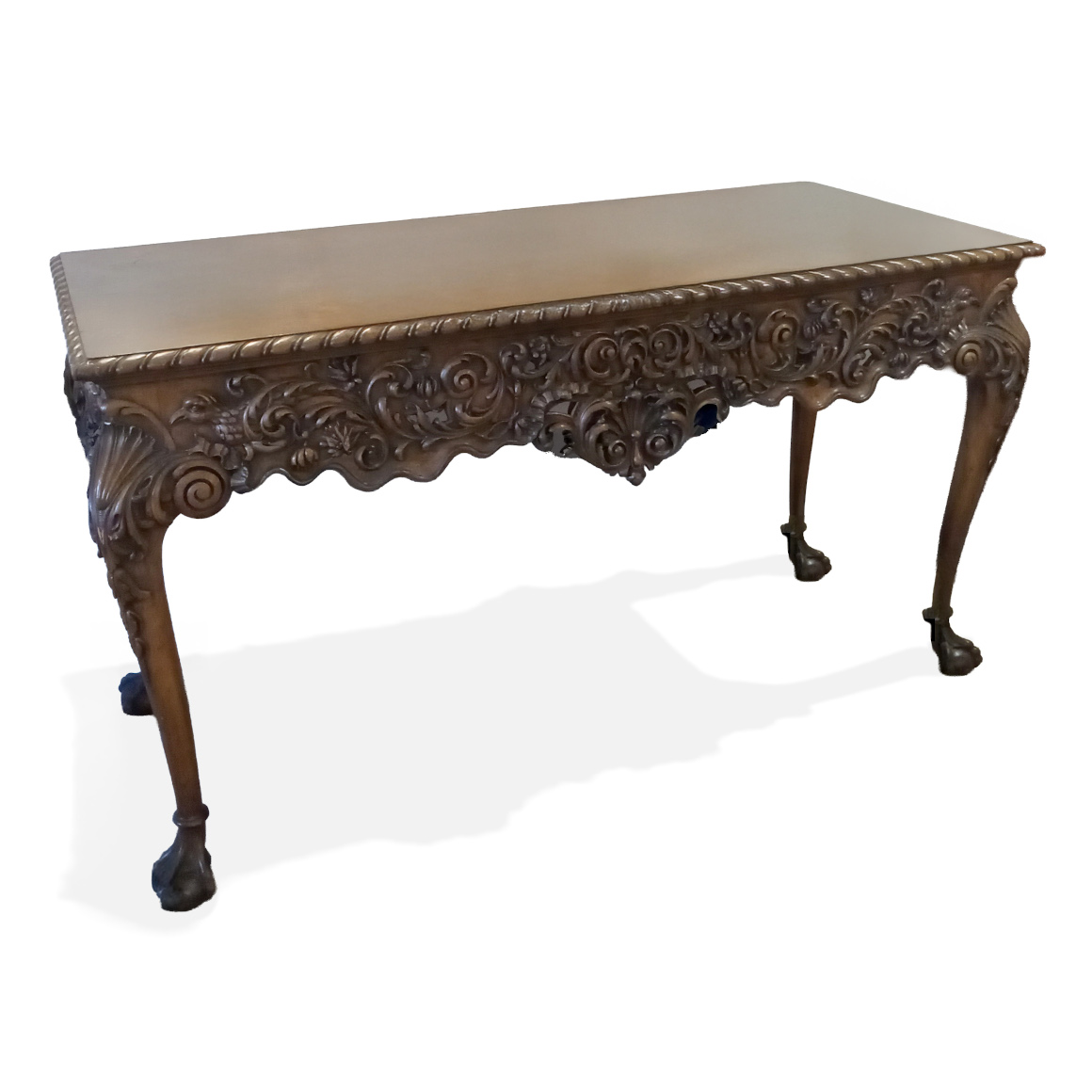
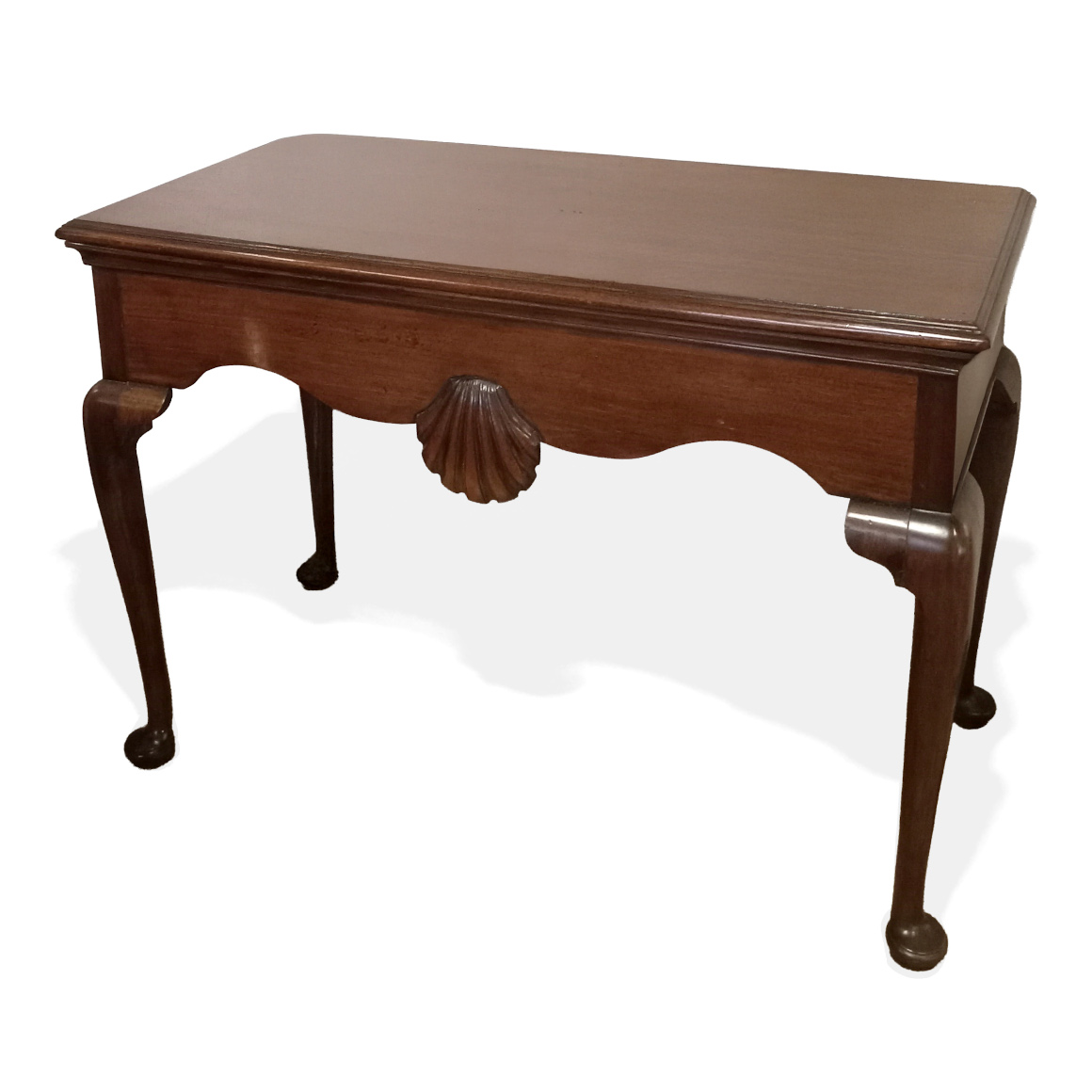
It seems difficult to believe that Irish furniture, with its inherently bold spirit and manifold eccentricities was often wrongly identified as ‘English’ or ‘American.’ However until recently, little was written or discussed regarding Irish furniture. The prevailing belief was that there existed a paucity of fine Hibernian antiques. Seemingly few pieces known to be Irish and a great lack of evidentiary documents such as accounts or bills made this perception difficult to refute. However during the eighteenth century, Ireland experienced periods of economic boom and a great increase in domestic industry, the latter in large part due to the effort of patriots such as the Bishop Berkeley and pamphleteer Samuel Madden who reproached the aristocracy for their absenteeism and instead advocated for patronage of the arts in their native country. Dedicated to the improvement of Irish culture, they established the Dublin Society in 1731 which began awarding prizes for fine and decorative arts, agriculture, and the planting of trees. Growing fortunes, deepening interest in the arts, and inspired patronage resulted in an effusion of goods from centers like Waterford, Cork, and Dublin. Prescribed also was the improvement of estates most notably evinced in the construction of grand houses in the Palladian style. Though the dominant taste in Ireland was for the Classical as it was throughout Europe, and influences from Italy and London could not be denied, Irish furniture was designed with its own sensibilities and idiosyncrasies such as the hairy paw foot, springy cabriole leg, and double back splat on chairs hence the description of a veritable mahogany menagerie from Le Fanu. But perhaps one of the first to seriously discuss the Irish contribution to design was historian Percy Macquoid in the third volume of his History of English Furniture - The Age of Mahogany 1720-1770. “The furniture, decorations and silver plate of Irish workmanship of this time shows great refinement of taste and perception of proportion.” Guilds in Dublin were already established, but the founding of a drawing school in 1746 improved the level of quality and craftsmanship of all design such that cabinetmakers established names for themselves and Ireland.

 
Irish Antique Dealers Association CINOA: Confédération Internationale des Négociants en Oeuvres d'Art Art & Antique Dealers League of America
© 2011 O'Sullivan Antiques New York & Dublin.
All rights reserved  

Designed by